

Creativity, Creators and Their Tools
Transformation beyond the means of production

Welcome to The Design Loft.
Today, we explore the role of tools in shaping what we create.
We are going to ask the question: what do tools do, and what do we become through their use?
We will discuss AI, but this isn’t another article on whether it is supplanting humans (there are enough of those out there); instead, we’ll look at why AI isn’t a designer.
We’ll also look at how creating things literally gets into your body. Today’s lesson aims to help you consider what you gain by taking the time, care, and attention to build, shape, and create, so you can make better things and become better at the same time.
Let’s get to it.
Our Tools for Creation
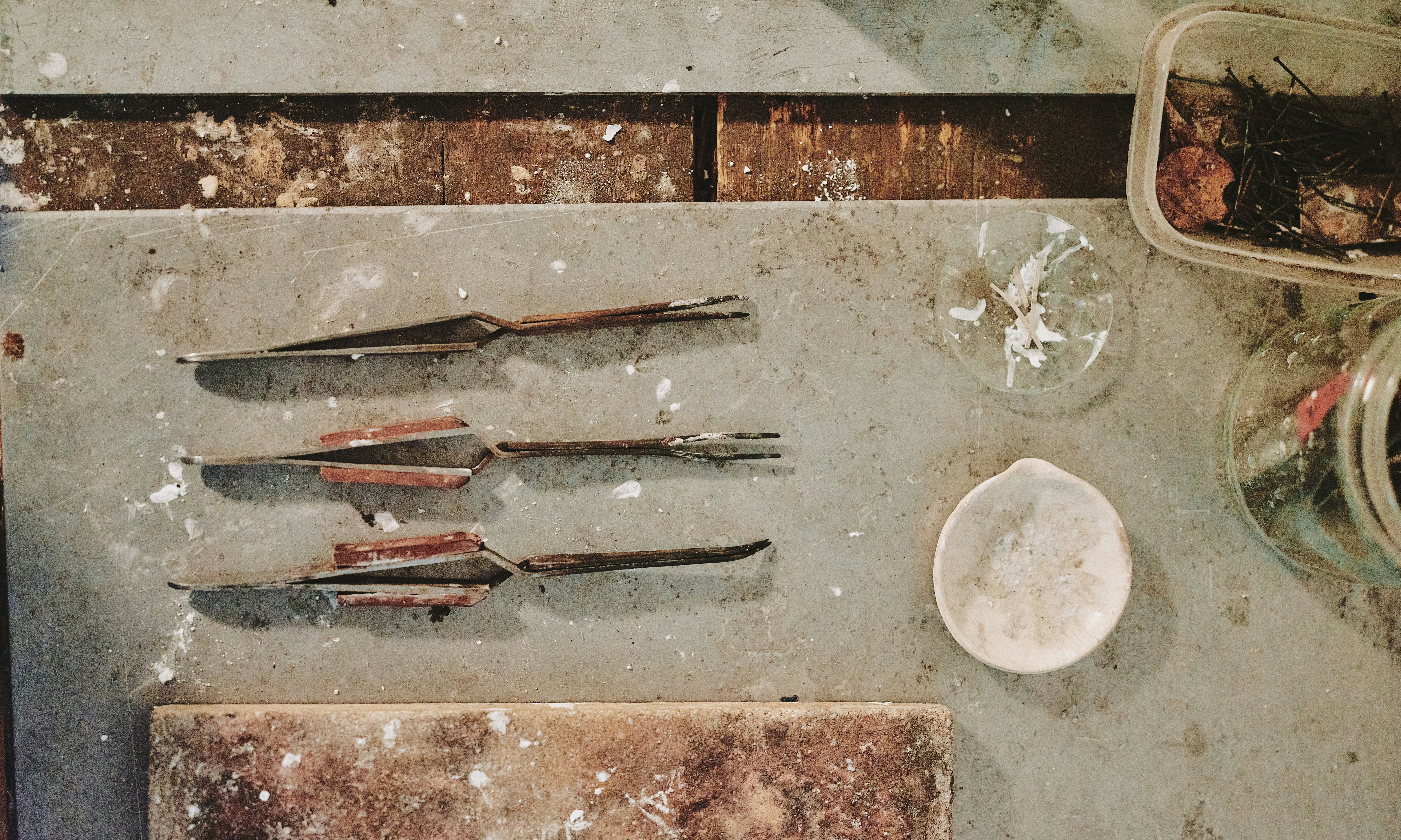
Humans are different than almost every other living thing by virtue of our use of tools. While birds might show ingenuity in creating their nests, they aren’t designing things the way we do, and that’s primarily because of our use of tools.
Tools are vehicles for skills, not ends in themselves. The discussion about the use of generative artificial intelligence (AI) often muddies the waters because it can seem that AI can create things on its own. AI is being described by many as an end in itself. While I’m not arguing against what AI creates (or how), it’s because it’s detached from the act of creation that I’m making a case that it won’t be replacing humans. I’ll discuss this below.
It’s through the act of doing something -- actively -- that we are more likely to learn, integrate existing ideas, remember, and build a different array of skills. Praxis is the awareness and exchange of ideas, knowledge, memory and skill through action. Making things with intention, care, reflection, and with application is what design is, and that is a praxis.
A straightforward example is handwriting. Handwriting is a better vehicle for integrating lessons from what’s written than typing. Recent research has shown that children’s academic performance declines when laptops are in the classroom. One reason that’s been considered is that screens don’t provide the multifaceted physiological means of making and integrating knowledge that physical things do, which have different cognitive demands.
Making is both a cognitive and an embodied process. When we create something with text, materials, or tools, we engage our brain, nervous system, and body in a collective action. This collective action helps us learn (increasing receptors) and integrate that learning (increasing receptor capacity).
Fit for Purpose

Your tools work when they are fit for purpose. This means understanding the purpose and role of your tools. What’s often overlooked in the discussion of tools is the ancillary benefits of their use. What will grant the most benefits, or the most appropriate benefits, through their use? What I’m referring to is the multidimensional use, outputs and outcomes that we derive from tools and their use.
(Even coffee can be used as a tool, as the meme above suggests).
If you’re looking to fell a tree, a chainsaw does it more efficiently than an axe. A laptop is a far faster means to write long prose than using a typewriter or by hand. A handset offers a broader array of tools and convenience than having a notebook, a calendar, a telephone, a video game console, etc., all separately. These are primarily about efficiency.
Note that we aren’t talking about quality. That’s a different dimension. It’s here that we turn to evaluation, which is about applying judgement to the merit, significance and worth of something.
When we evaluate what we create through our designs, we consider a variety of things, depending on the purpose. Returning to the matter of laptops in the classroom, one possible reason they don’t promote learning as well as other things is that they prioritize the efficiency of content delivery (and ease) over other metrics.
As John Stone writes, sometimes a little friction is a good thing. In writing about the use of AI in recruitment, education, and more, he notes the problems of efficiency:
We automated the production of artifacts but haven’t fixed judgment. The result is a marketplace of immaculate verbiage with very little meaning, of noise without signal.
Everyone looks more “efficient.” Very little about it feels effective.
This is where being clear on what your tools do and the benefits that slow, connected (or solitary), friction-filled or frictionless creation brings. We’ll be exploring much more of this in the new year.
Embodied Knowledge: Notes on AI
AI can only work with what it has. If you’ve not fed into a system data that reflects what is learned, how, and how that learning is applied -- which is embodied in people and part of a praxis -- then it can’t be included in an LLM. An AI agent might surmise things, but it doesn’t know.
It’s one of the many reasons there are legitimate concerns about who is left out of large language models. In many communities, knowledge is embodied in actions, memories, and stories that aren’t recorded digitally. Even your notebook scribbles aren’t part of the knowledge-sphere that AI can tap into unless they are digitized. Our entire non-digital experience is alien to an LLM. Some communities — particularly indigenous ones — embrace oral traditions and have limited recorded ‘material’ to feed into an LLM. They will be excluded from the models and creations that LLMs produce.
Likewise, you and I are products of our experiences. Not all the knowledge we have can be verbalized; it can only be enacted. Tools allow us to enact some of this knowledge through our creations. Clinical experience, for example, is not just an accumulation of facts; it’s the lived experience of health praxis.
Good leadership isn’t just a set of techniques; it’s the design of teams, organizations, and performance enacted through practice. Our tools — cognitive, physical, and experiential — allow us to shape things.
Tools and References
If you’re looking to learn about tools for design, we have you covered. Paid members have access to our ever-evolving learning library, and below are some references to a few selected places where you can learn about and select tools that can help you in your design journey right now.
Of course, one way to learn about these is to sign up as a premium member to access our events and coaching that you can’t get anywhere else.
Kumar, Vijay. 101 Design Methods: A Structured Approach for Driving Innovation in Your Organization. John Wiley & Sons, 2012.
Vijay Kumar’s 101 Design Methods offers a comprehensive toolkit for approaching innovation as a disciplined, reliable, and repeatable practice rather than an ad-hoc or purely creative endeavour. The book structures over one hundred methods into a framework of seven modes—from Sense Intent through Know Context, Know People, Frame Insights, Explore Concepts, Frame Solutions, to Realize Offerings—each corresponding to phases of the design innovation process. Methods are presented with clear guidance on purpose, input, output, and application, making the book both a practical reference for practitioners and a pedagogical resource for teaching design methods. Kumar emphasizes that innovation can be planned and managed systematically, integrating research, synthesis, and creation activities to enhance outcomes across organizational contexts.
Service Design Toolkit. Nahmahn and partners have published a service design toolkit that is aimed at complex situations. A practical, introductory toolkit for understanding and applying service design—a human-centred approach to improving services for users and staff.
Mueller, P. A., & Oppenheimer, D. M. (2014). The Pen Is Mightier Than the Keyboard: Advantages of Longhand Over Laptop Note Taking. Psychological Science. This research found that students who took handwritten notes performed better on conceptual and memory tests than students who typed their notes, suggesting deeper cognitive processing in handwriting. Link.